These exhibitions focus on the conditions a community inherits rather than chooses: ecological loss, the residue of empire, the weight of being looked at from outside, prolonged political uncertainty, and shifting ideas of home in places changing at a different pace than the people who live in them. Across the selection, identity is understood as something shaped by history and environment, as well as by how artists actively engage with those forces, rather than something fixed or simply declared. The works span a variety of forms: native storytelling, puppetry, papier-mâché, embroidery, and painting. Together, they use art as a means of holding contradiction, exhaustion, pain, ambivalence, and the vastness of history without resolving it into certainty or spectacle.
“Marking the pavilion's centenary, the exhibition follows an exhausted actor who has played a beloved cartoon mole for decades, utilising a children's mascot as a vessel for meditation on Czech-Slovak coexistence and collective memory.”
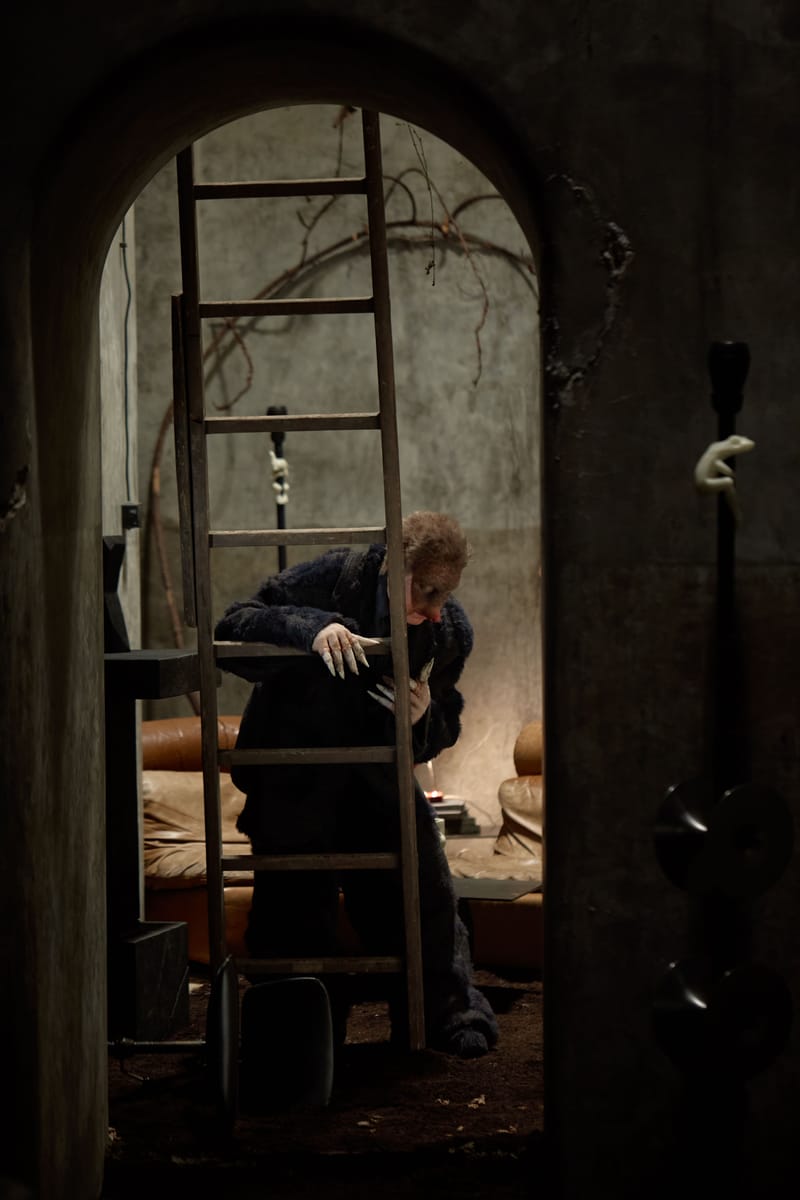
Czech Republic & Slovak Republic Pavilion · Marking the Czechoslovak Pavilion's centenary, 'The Silence of the Mole' follows Mr. M., an exhausted actor who has played the beloved cartoon Mole for decades — using a children's mascot as a vessel for meditation on Czech-Slovak coexistence and collective memory. Staged in the Giardini.
“The inaugural cohort of the Bukhara Biennial Curatorial School gathers seven artists to consider the Aral Sea — a critical lake drained by Soviet cotton agricultural interests — through the storytelling of the Karakalpak-Uzbek traditions.”
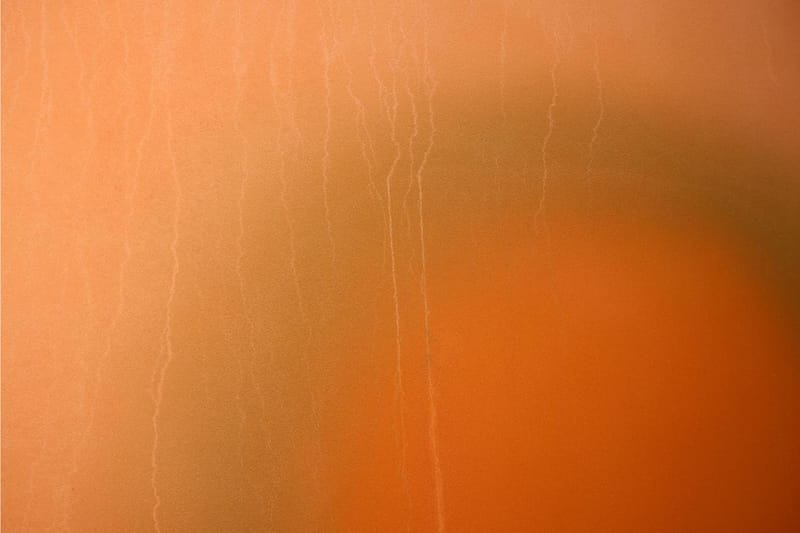
Uzbekistan Pavilion · The inaugural cohort of the Bukhara Biennial Curatorial School gathers seven artists to consider the Aral Sea — once the world's fourth-largest lake, now over 90% gone after Soviet-era cotton-irrigation diversion — through the storytelling traditions of the Karakalpak-Uzbek peoples. Curated by a team across Tashkent, Tokyo, NYC, and Hanoi for the Uzbekistan Pavilion at the Arsenale.
“A seventeen-metre-wide painting of frail bodies composed neatly together across a Kosovar mountain landscape, portraying the act of waiting as the inherited condition of a country whose recognition is still being negotiated.”
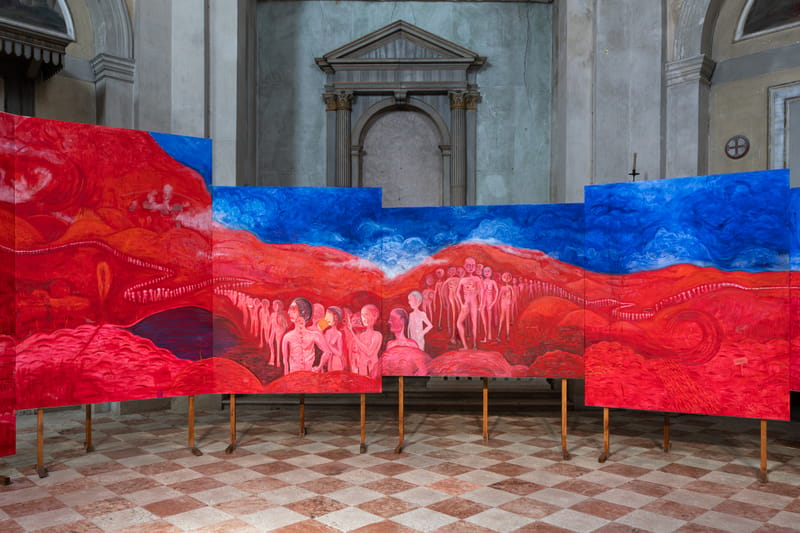
Kosovo Pavilion · Brilant Milazimi presents a seventeen-metre-wide painting of frail bodies composed neatly together across a Kosovar mountain landscape, portraying the act of waiting as the inherited condition of a country whose recognition is still being negotiated. The Kosovo Pavilion reopens the closed 17th-century Chiesa di Santa Maria del Pianto near the Fondamenta Nuove, unsealed specifically for the Biennale.
“Cast entirely in Zaum — the irrational esoteric language of the Russian Futurists — the exhibition examines Albania as a 'somewhere place' defined by a century of external projection, drawing on a 1916 avant-garde magazine reducing the country to an exoticised image.”
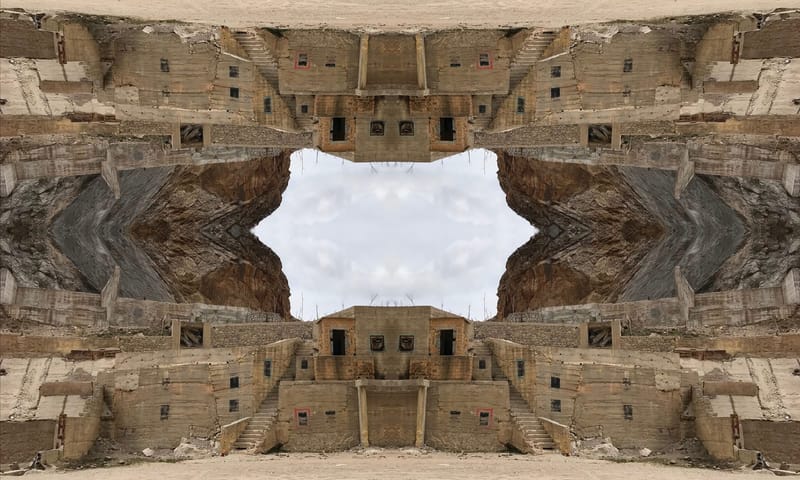
Albania Pavilion · Cast entirely in Zaum — the irrational esoteric language of the Russian Futurists — Genti Korini's three-channel video for the Albanian Pavilion examines Albania as a 'somewhere place' defined by a century of external projection, drawing on a 1916 Petrograd avant-garde magazine that satirised Russian imperial pretensions through an orientalised image of the country. A fictional theatre fusing live acting, puppetry, and animation.
“Working in clay, embroidered thread, papier-mâché, and recycled organic materials, the exhibitors render the concept of home as a portable condition; part memory, part material, part ritual, held as a diasporic counterweight against the speed of contemporary Indian urbanisation.”
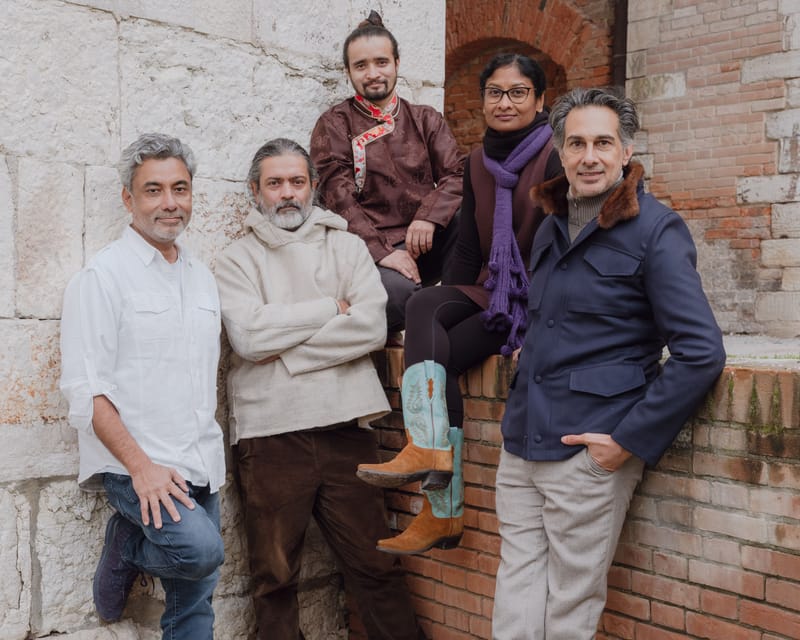
India Pavilion · Working in clay, embroidered thread, paper mâché, and recycled organic materials, five artists — Alwar Balasubramaniam (Bala), Sumakshi Singh, Ranjani Shettar, Asim Waqif, and Ladakhi thangka-and-pashmina artist Skarma Sonam Tashi — render the concept of home as a portable condition: part memory, part material, part ritual, held as a diasporic counterweight against the speed of contemporary Indian urbanisation. India's first Venice pavilion in seven years, curated by Amin Jaffer and presented by the Ministry of Culture, Government of India, in partnership with the Nita Mukesh Ambani Cultural Centre and Serendipity Arts Foundation.
